MP3 vs Lossless on Cheap Earphones: Can You Actually Hear the Difference?
This question usually gets one of two useless answers. Either “of course, lossless is obviously better,” or “nobody can hear the difference, it’s placebo.”
Both are wrong in the same way: they treat it as one question when it is really three. At what bitrate? On what material? Compared against what?
Here is what the evidence actually supports, and where earphones fit into it — which is lower down the list than most people assume.
The large-scale result
The most useful data point is not from an audiophile forum. It is from NPR’s public audio quality quiz, which asked a very large general audience to pick the lossless WAV from among three files.
Random guessing between three choices scores 33.3%. The audience scored 36.0%.
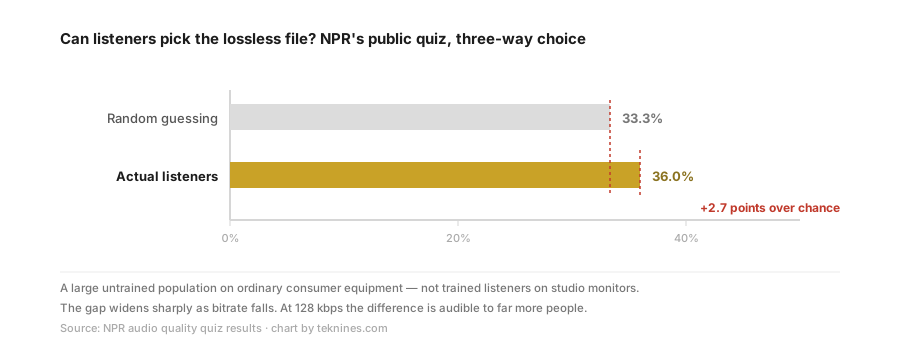
Two-point-seven percentage points above chance. Not zero — the difference is real and some people found it — but nothing like the confident certainty the debate is usually conducted with.
Set against that, forum ABX results scatter widely. Some testers score 21 out of 25 on 320 kbps against WAV. Others cannot beat chance at all. Both results can be true, because ABX outcomes depend enormously on the specific track, the specific passage, and whether the listener knows which artefact to listen for.
The general finding from the academic side is that MP3 is transparent on roughly 90% of material at high bitrates. The interesting 10% is the part worth understanding.
Where the audible threshold actually sits
Rough, honest guidance rather than a hard rule:
| Bitrate | In practice |
|---|---|
| 64 kbps and below | Obvious to almost everyone. Watery, smeared, hollow |
| 96–128 kbps | Audible to many listeners on the right material — cymbals, applause, reverb tails, room ambience |
| 160–192 kbps | Difficult for most people. Occasional giveaways on hard material |
| 256–320 kbps | Very hard. Most listeners cannot beat chance in blind conditions |
| Lossless | The reference |
Two things move that threshold more than gear does:
Codec generation. Modern codecs are more efficient at the same bitrate. AAC and Opus generally hold up better at 128 kbps than MP3 does — which matters, because short-form video platforms deliver AAC at around that bitrate.
Material. Lossy codecs fail on specific things: applause, hi-hats and cymbals, harpsichord, solo piano decay, and the tail of a reverb in a quiet passage. They cope very well with dense, loud, bass-led mixes. This is why “I can’t hear it on my music” and “I can definitely hear it” are frequently both true statements about different libraries.
What the codec actually removes
You can see it, which helps. Below, the same passage as a lossless WAV on the left and a 96 kbps MP3 on the right, shown as waveform and spectrogram.
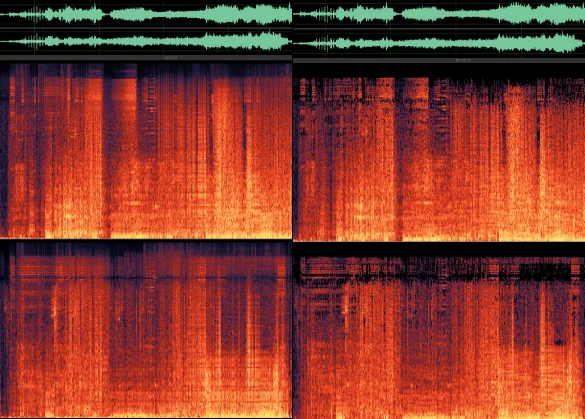
Lossless WAV (left) and 96 kbps MP3 (right). Image by ItzaGarciaOrdonez, CC BY-SA 4.0, via Wikimedia Commons.

Two things to take from that picture, and one thing not to.
Take: the waveforms are almost identical. Loudness and dynamics survive compression nearly intact, which is why lossy audio does not sound obviously “damaged” on casual listening.
Take: the missing band is at the top. That is where cymbals, sibilance and air live, and it is why the artefacts of compression are a treble phenomenon — and therefore why a soft-topped earphone conceals them.
Do not take: that a bigger dark band means proportionally worse sound. This is 96 kbps, chosen to make the effect visible. At 256–320 kbps the difference is far smaller and lives in detail the eye reads as noise. A spectrogram shows you what was removed; it cannot show you what was audible.
Where the earphone comes in
Now the part the question was actually about.
A revealing earphone helps you hear compression artefacts. A warm one hides them.
That is the whole effect, and it cuts both ways:
- The Munitio NINES have a soft top end and “sub-par clarity.” That is precisely the tuning that masks codec artefacts, which live mostly in the treble. On a 128 kbps stream they sound better than a more accurate earphone at the same price. They also cannot show you what lossless would give you.
- A bright, detailed earphone does the reverse. It rewards good files and exposes bad ones.
So the honest answer to “will lossless sound better on cheap earphones” is: usually less than it would on revealing ones, because the tuning that makes budget earphones pleasant is the same tuning that conceals what you are trying to hear.
But note the ordering. The earphone is a modifier. The bitrate is the variable. Going from 128 kbps to lossless on modest earphones changes more than upgrading earphones while staying at 128 kbps — provided your seal is good, which is a bigger factor still and is covered in the fit guide.
A practical hierarchy
If you want better sound and have limited effort to spend, in order:
- Fix your seal. Free, takes a minute, larger effect than anything below it.
- Stop listening below about 160 kbps where you have the choice. This is where audible losses actually live.
- Choose an earphone whose tuning suits your library, not one whose specification sheet looks impressive.
- Go lossless. Real, and the smallest step of the four for most people on most material.
That last line is not an argument against lossless. Storage and bandwidth are cheap now; there is no reason to accept lossy when you have the choice. It is an argument against expecting it to transform anything.
The case where it genuinely matters
One exception is worth flagging, because it is the situation where lossy compression stops being a matter of taste: when the file will be encoded again.
Every lossy encode discards information permanently. Encode a 128 kbps file a second time — because you edited it, or uploaded it somewhere that transcodes everything — and the second encoder is working from already damaged material and throws away more. Two or three generations in, the loss is obvious to anyone.
That is not hypothetical. It is the normal path of any audio that passes through a social video platform, and it is the subject of the next piece.