In-Ear Monitor Fit Guide: Why Most People Use the Wrong Ear Tips
Most people put in the medium tips, notice the earphone sounds a bit thin, and conclude they bought a thin-sounding earphone.
Often they did not. They bought a normal earphone and are listening to it through a leak.
The ear tip is the least expensive thing in the box and the component with the largest effect on what you hear. It is also the only one you can change in thirty seconds and for almost no money, which makes it the highest-return adjustment available to anyone using in-ear monitors.
Why the seal matters so much
An in-ear monitor does not work like a loudspeaker in a room. It works by sealing your ear canal and turning the space between the driver and your eardrum into a small closed pressure chamber.
Break that seal anywhere and low frequencies escape first, because long wavelengths need the chamber to be closed in order to build pressure at all. Treble is barely affected. So a leaking earphone does not sound quiet — it sounds thin, bright and hollow, which most people interpret as “bad bass” or “harsh.”
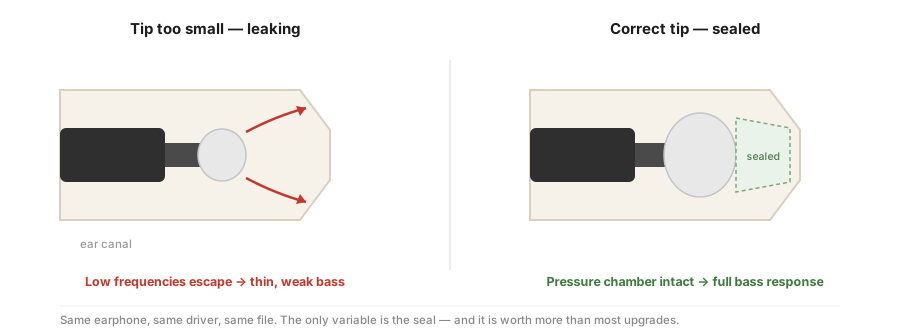
The seal test, in ten seconds
No equipment needed:
- Put the earphones in and play something with steady bass.
- Press each earphone gently further into your ear with a fingertip.
- If the bass suddenly gets noticeably fuller, you do not have a seal.
If nothing changes, you are sealed and the tuning you hear is the tuning the designer intended.
A second check: with music paused, insert them and speak. A sealed earphone makes your own voice sound boomy and internal. If your voice sounds normal, air is getting out.
Choosing a size — and the rule people get wrong
The rule most people follow is “pick the size that fits.” The better rule is:
Pick the largest size you can wear comfortably for an hour.
Most people under-size. A tip that feels slightly snug on insertion usually settles within a minute as the silicone warms, and it will hold its seal when you walk, chew or turn your head — which is when marginal seals fail.
Two further points:
- Your ears are not the same size as each other. Mixing sizes — say medium left, large right — is completely normal and manufacturers ship enough tips to allow it. Very few people try it.
- Insertion depth matters as much as diameter. A smaller tip inserted deeper often seals better than a larger tip sitting shallow, and it will sound different: deeper insertion generally lifts the treble.
It helps to know what you are inserting into. The ear canal is not a straight tube — it curves, and its diameter changes along its length, which is why a tip that seals easily at shallow depth may not seal at all when pushed further, and vice versa.


This is also why the two ears so often need different sizes: the canals are rarely symmetric.
Silicone versus foam
| Silicone | Memory foam | |
|---|---|---|
| Seal quality | Good when correctly sized | Excellent, more forgiving |
| Isolation | Moderate | Higher |
| Treble | Brighter, more open | Slightly softened |
| Comfort over hours | Can create pressure points | Usually more comfortable |
| Lifespan | Years, then hardens | Months — foam loses rebound |
| Hygiene | Wipe clean | Absorbs, needs replacing |
Foam is the right answer if you cannot get a reliable seal with silicone, if you want more isolation, or if your ear canals are asymmetric enough that stock tips never quite work. The cost is that foam is consumable — expect to replace it once or twice a year.
Foam also slightly softens the treble. On an earphone that is already warm and soft — the Munitio NINES being a good example — foam can push it too far. On a bright earphone it is often exactly the fix.
The thing nobody mentions: stock tips age
Silicone hardens and shrinks over years. It is gradual, so you do not notice it happening; you just slowly stop getting a good seal and conclude the earphones have “lost their bass.”
They have not. The tips have.
This matters especially for older or discontinued models. If you are buying a fifteen-year-old design second-hand, budget for new tips and check the nozzle diameter first — a 5 mm nozzle takes common third-party tips, an unusual one may not. That single check is the difference between a usable purchase and an ornament.
When the tip is not the problem
Three cases where changing tips will not save you:
- Genuinely poor drivers. No seal recovers detail that was never produced. As the piece on shape-led earphones argues, the driver is most of the answer and the tip cannot substitute for it.
- A tuning you dislike. A seal restores the intended sound. If the intended sound is a soft, wooly top end, sealing properly gives you more of it, not less.
- The source file. A perfect seal on a low-bitrate stream still gives you a low-bitrate stream — though, as the compression piece sets out, that matters less than most people assume.
Fix the seal first anyway. It costs nothing, it takes a minute, and until it is right you are not actually hearing the product you bought.