Munitio NINES Review: The 9mm Bullet Earphones Are Still on Sale in 2026
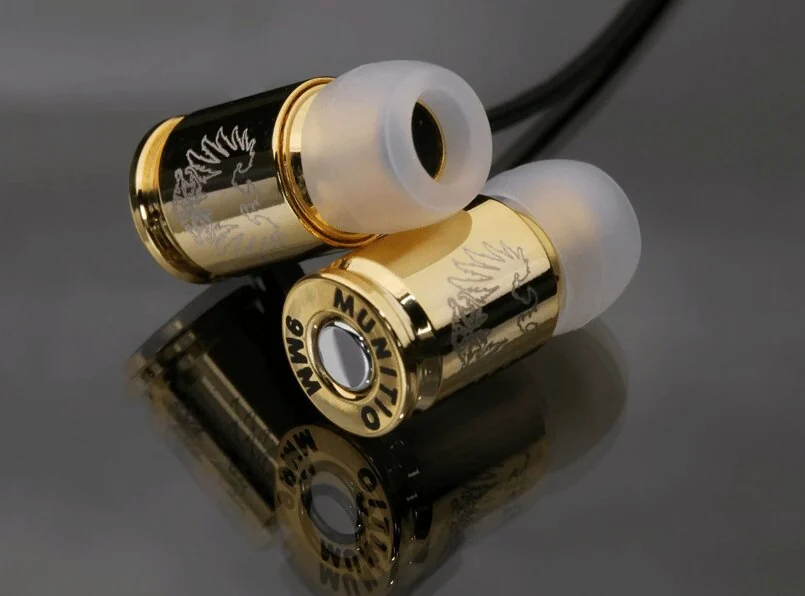
Most earphones with a gimmick get eighteen months. The Munitio NINES have had fifteen years, and as of this week they are still listed on the manufacturer’s own store at $199 in silver, black and gold, all three in stock.
That alone makes them worth writing about. Novelty audio almost never survives that long. So the question is not whether these are a curiosity — clearly they are more than that — but whether the thing you are paying for is the machining or the sound.
Short answer: it is the machining. That is not necessarily a reason to skip them, but you should know it going in.
What they actually are
The NINES are in-ear monitors whose housings are machined from a single piece of copper alloy and finished in titanium or gold, shaped and sized like a nine-millimetre round. The brand logo is engraved on the shell and the nozzles sit behind mesh filters. They are sold as “In-Ear Tactical Headphones,” which tells you more about the marketing than the engineering.
The engineering itself is deliberately conventional:
| Driver | Single dynamic, 9mm |
| Sensitivity | 98 dB |
| Frequency range | 12 – 22,000 Hz |
| Nozzle | 5 mm |
| Cable | 4 ft, Kevlar-reinforced, fixed |
| Mic/remote | 1-button and 3-button versions |
| Wear style | Straight down or over-ear |
| Price today | $199 direct |
A single dynamic driver at 98 dB is an ordinary specification. Nothing here is trying to be a technical statement. The statement is the metal — right down to the base of each housing, which is stamped MUNITIO 9MM around the rim in the position a real cartridge carries its headstamp. That detail is the entire product thesis in one machining pass.
How they sound
I will be blunt, because the marketing is not.
The most thorough measurement-and-listening writeup of the NINES, The Headphone List’s review of the Teknine SITi, scores the sound 6.2 out of 10 while scoring build quality 4.5 out of 5. That gap is the whole product in two numbers.
The description is worth quoting because it is precise: “tons of bass,” a presentation that is “obscenely smooth and non-fatiguing,” but also “sub-par clarity” and an “overly soft and wooly sound.”
That is a coherent tuning, not a broken one. A big, soft, warm low end with the treble pulled back is genuinely pleasant on hip-hop, electronic music and podcasts, and it is forgiving of bad source files — which, in 2010 and arguably still now, describes most of what people actually listen to on the move. What it is not is detailed. If you want to hear the reverb tail on a snare, this is the wrong purchase at any price.
Two practical consequences of the tuning:
- They flatter compressed audio. The soft top end hides the artefacts that make low-bitrate streams sound brittle. On a 128 kbps stream these sound considerably better than a more revealing earphone at the same price.
- They punish good recordings. A well-mastered acoustic track gets the same wool blanket. The NINES do not scale with source quality; what you get is what you get.
Build: the good part, and the two weak points
The housings deserve their reputation. Machined metal, no visible seams, satisfying weight, a finish that survives pockets. Nothing at $199 feels this solid in the hand, and after fifteen years that is a claim you can now check against reality rather than a press release.
But the same review flags two specific weaknesses, and both are worth knowing before you buy:
- The cable cinch “tends to let go of one side of the cable when tightened.”
- The cable itself has a “mild tendency to kink” despite the Kevlar.
Neither is dramatic on day one. Both matter over years, and they matter more here than on a plastic earphone, because heavy metal housings put constant load on the cable joint every time the earphones swing from your neck. Kevlar slows that; it does not repeal it.
The third weakness is not a defect but a design decision: the cable is fixed, not detachable. No MMCX, no 2-pin. That was normal in 2010 and is much less normal now. It means the failure of one cable ends the product, regardless of how good the housings still are. At $199 in 2026, competing against IEMs with replaceable cables at half the price, this is the single hardest thing to defend.
Fit is good but firm — the housings are heavy for their size, and the thick stock tips are part of how they seal. If you replace the tips with something thinner, expect the bass to loosen.
The price question
Here is the part that surprised me.
The NINES launched at $169. They sell today at $199. Fifteen years, no redesign that I can find, and the price went up about 18 percent.
The Pro40 over-ear tells the same story: launch MSRP $349.99, and it was discounted to around $245 on Amazon at the time it was being reviewed. Today it lists at $399 on the manufacturer’s store.
Draw your own conclusion, but mine is that this is a brand that has stopped competing on price and is selling to people who want the object. That is a legitimate business — plenty of accessories work this way — but it means you should not expect the value calculation to improve by waiting.
If you want the NINES for the sound, there are better options at $199, and there were better options at $169 in 2010. If you want the NINES because you want machined bullet casings in your ears and you also want them to sound warm and pleasant, then the price is the price and no review is going to change your mind. That is fine. Just be honest with yourself about which one you are.
The rest of the line
The NINES are no longer the only thing Munitio makes. The current catalogue runs to three audio products:
Pro30 — $349, wireless on-ear
Marketed as “Tactical Wireless Headphones,” available in gunmetal, black and gold. Historically these have shown up heavily discounted through third-party channels, which is worth checking before paying list.
Pro40 — $399, over-ear
This is the interesting one, and by the numbers it is the better product.
| Driver | 40 mm, titanium-coated |
| Impedance | 32 Ω |
| Sensitivity | 102 dB SPL/1 mW |
| Frequency response | 12 – 20,000 Hz |
| Cable | Detachable — 4 ft straight with mic/remote, 8 ft coiled with ¼” adapter |
| Construction | Aluminium alloy, “CODA AXIS” earcup articulation |
The Headphone List scored the Pro40 considerably higher than the NINES: build 10/10, comfort 8.5, isolation 8, sound 7.75. The verdict — “smooth sound underpinned by powerful bass,” bass with “both great impact and depth,” mids “thick enough that they don’t get crowded out,” treble “smooth and forgiving” — describes the same house tuning as the NINES, executed better.
The summary line is the one to remember: “a good bass-heavy headphone with bulletproof construction.”
Note what changed between the two products: the Pro40’s cable detaches. Whatever else you think of the brand, they learned the right lesson from the NINES. The one comfort caveat is that the protein leather earpads “can get a touch warm with extended wear,” which is the standard tradeoff for good passive isolation.
Also on the store: the Borsa30 utility pouch at $80, which is not audio and which I have no opinion about.
Verdict
Buy the NINES if you want a machined metal in-ear with a warm, thick, forgiving sound, you mostly listen to bass-led music or spoken word, and you accept that a fixed cable gives the product a finite life. The build genuinely is exceptional and the tuning genuinely is pleasant.
Skip them if clarity matters to you, or if you have been spoiled by detachable cables. At $199 the competition is fierce and most of it sounds better.
Consider the Pro40 instead if $399 is within reach and you can live with over-ear. It is the same sonic philosophy with better execution, better scores across the board, and a cable you can replace — which, fifteen years into this line’s history, turns out to be the specification that decides how long a pair lasts.
Specifications and prices in this article were checked against the manufacturer’s store and the linked reviews on 3 September 2026. This site is independent and has no affiliation with Munitio.